





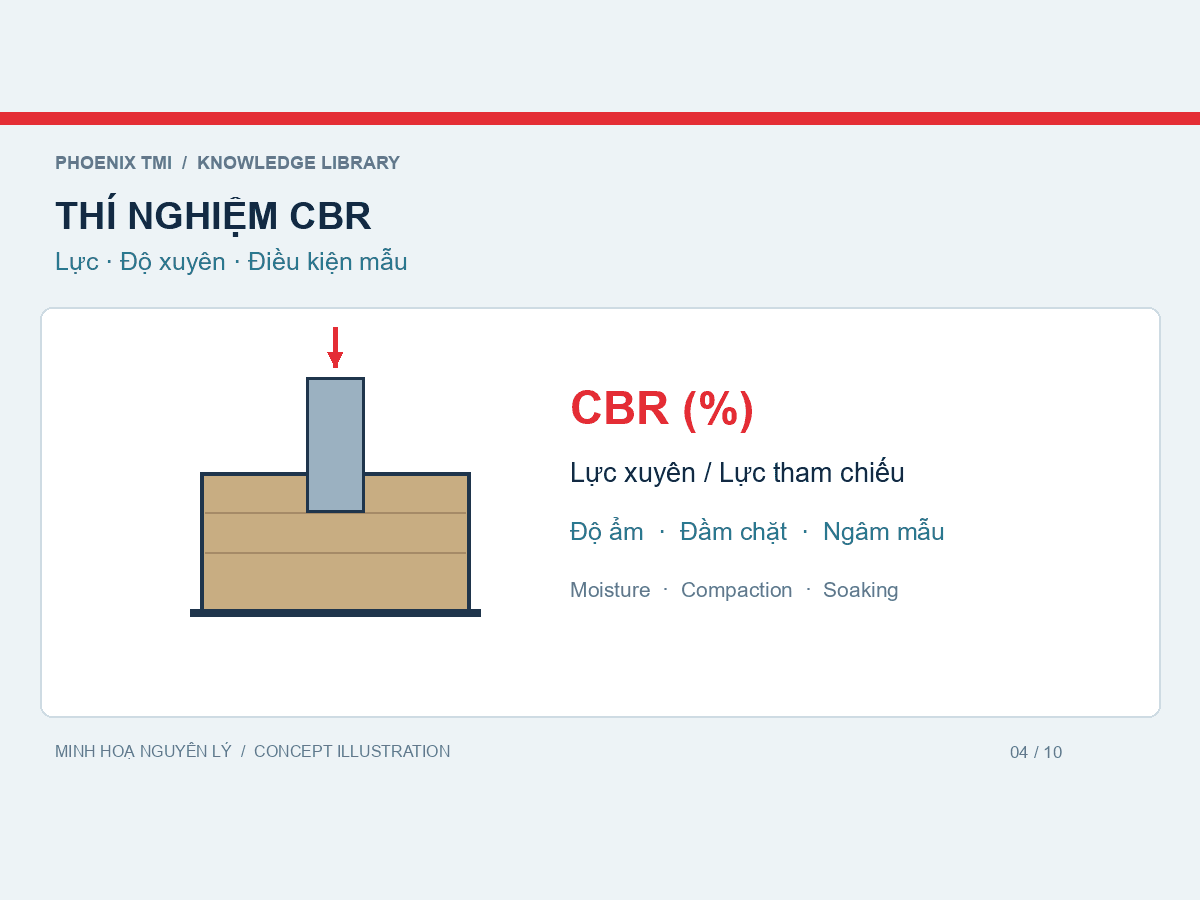
California Bearing Ratio (CBR) is a relative bearing index for pavement subgrade and base materials obtained through a penetration test. Its meaning depends on specimen preparation and conditioning; the percentage alone is not a complete material description.
Concept illustration prepared for Phoenix TMI; not measured data or a manufacturing drawing.
What does the test measure?
A penetration piston advances into a prepared specimen in a mould. Measured loads at specified penetrations are compared with reference loads using the required method. CBR is a percentage, not compressive strength in MPa or a direct measurement of elastic modulus.
Conditions that must accompany the result
Condition | Why it matters |
|---|---|
Moisture | Different moisture states can change penetration resistance. |
Dry density | Compaction affects the structure and response of the material. |
Soaked or unsoaked | These are distinct conditioning cases and must be identified. |
Preparation history | Specimen preparation and conditioning support traceability. |
Do not substitute an unsoaked result for a soaked requirement or compare specimens prepared to different compaction states without noting the difference. Acceptance limits come from the project and specified method, rather than a universal threshold.
Selecting the test system
A loading frame with the required movement control.
Compatible moulds, piston, surcharge masses and preparation accessories.
Synchronized force and penetration measurements with suitable ranges.
A stable displacement reference: machine crosshead movement is not automatically specimen penetration.
Keep the curve, not only the final percentage
A load–penetration curve can reveal poor initial contact or an unstable measurement setup. Apply curve corrections and reporting rules from the specified method; do not adjust data to obtain a preferred result.
Discussing a Phoenix TMI configuration
For Phoenix TMI Auriga 50 kN, identify the CBR method, moulds, daily workload and data requirements when requesting a configuration. A combined CBR/Marshall requirement needs distinct fixtures, measurement arrangements and operating settings for the two tests.
A useful report retains specimen identification, preparation moisture and density, soaking condition, the load–penetration curve and the result calculation method.
References
This article explains principles and equipment selection. Perform testing to the required standard and equipment instructions.


