





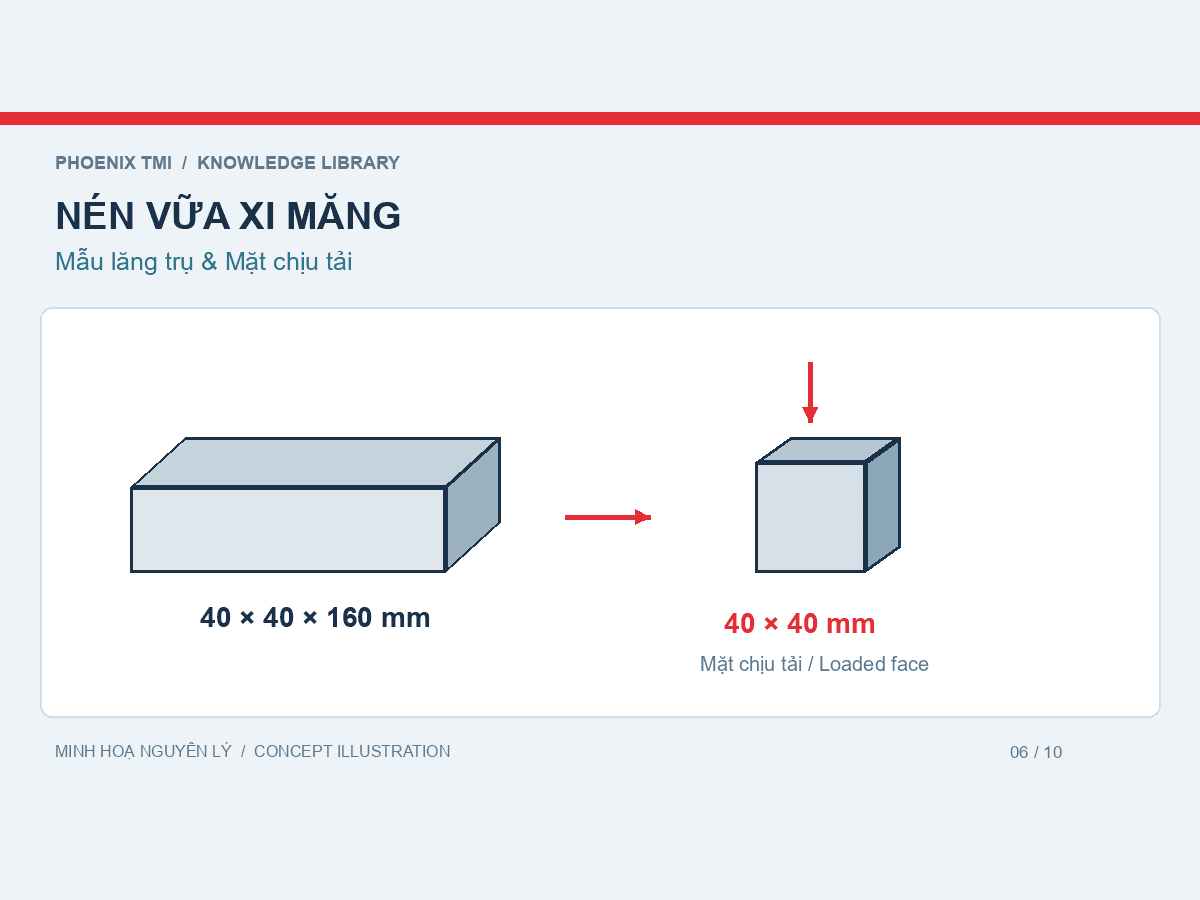
Cement strength is assessed using mortar specimens prepared to a defined method, rather than by directly compressing dry cement powder. Preparation, curing, specimen positioning and loading all contribute to the result.
Concept illustration prepared for Phoenix TMI; not measured data or a manufacturing drawing.
Prism dimensions are not the compression area
In a method using 40 × 40 × 160 mm mortar prisms, 160 mm describes the original specimen length. For compression after flexure, prism portions are loaded through the prescribed fixture and loaded area. Do not assume the full 40 × 160 mm face is the area used to calculate compressive strength.
A 50 mm cube method is a different system. Do not convert results between cube and prism methods using a simple geometric ratio.
Keep the preparation chain traceable
Stage | Records to retain |
|---|---|
Mixing and moulding | Materials, mixing and compaction procedure, mould identification. |
Curing | Age, environment and removal time. |
Positioning | Loaded faces, specimen condition and fixture. |
Loading and calculation | Failure load, loaded area, units and assessment rules. |
Capacity versus useful measurement range
Select the machine against expected failure loads and its verified force measurement range. Maximum capacity does not guarantee suitable measurement at every low load; display resolution is not a substitute for force verification or calibration.
Configuring Phoenix TMI Pisces
For Phoenix TMI Pisces 300 kN, specify the method, specimen dimensions, compression fixture, expected loads and recording needs. If flexural testing is required, confirm the separate equipment and accessories. Compression capability alone does not establish a complete flexural test setup.
Reporting errors to avoid
Using the prism’s long face as the compression area.
Mixing kN and N or inconsistent dimensional units.
Combining ages or curing conditions without identification.
Retaining only the final strength and losing each specimen’s load record.
A traceable report links each strength result to its load, area, specimen and conditions, making unusual results easier to investigate.
References
This article explains principles and equipment selection. Perform testing to the required standard and equipment instructions.


