





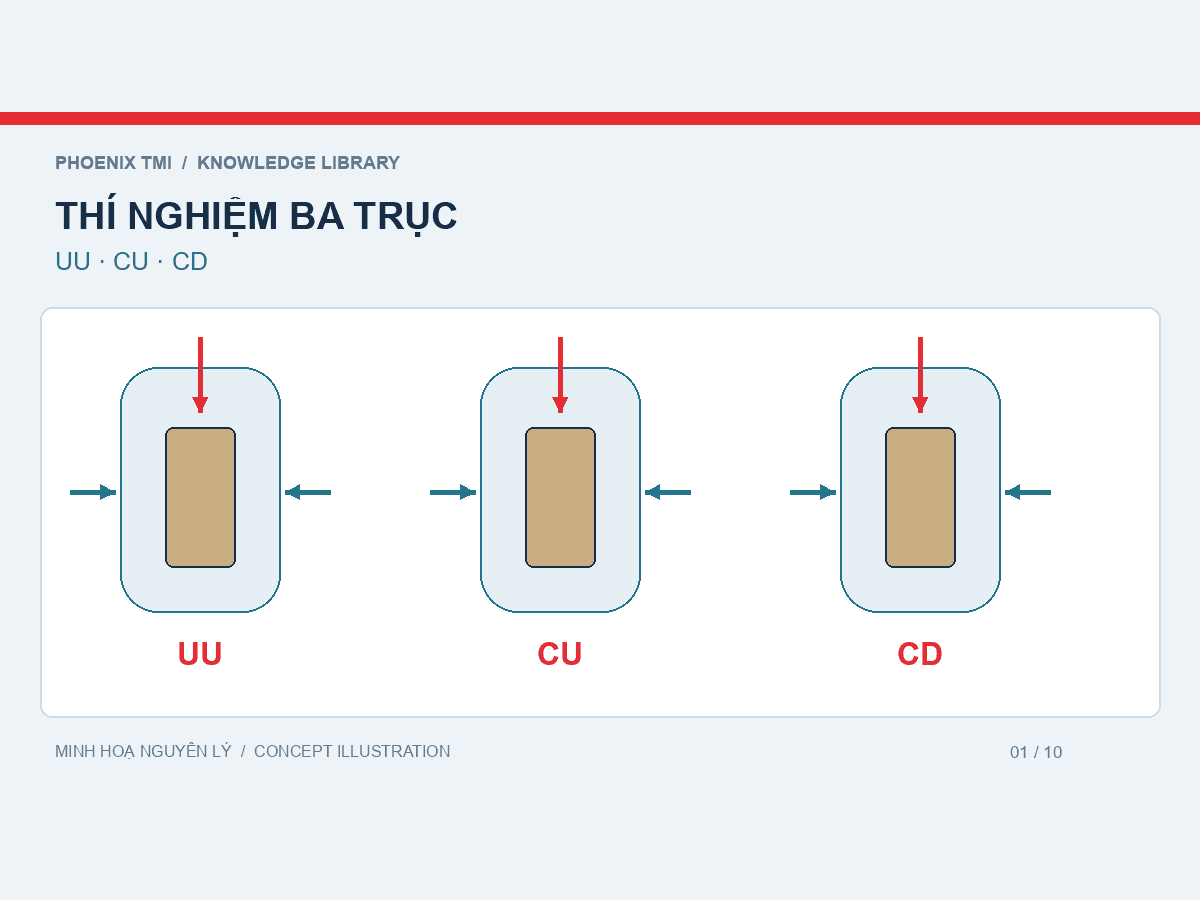
Triaxial testing examines soil response to controlled confinement and axial loading. UU, CU and CD describe different drainage conditions; they should not be treated as interchangeable test labels.
Concept illustration prepared for Phoenix TMI; not measured data or a manufacturing drawing.
What the system controls
A membrane-enclosed cylindrical specimen sits inside a pressure cell while the frame compresses it axially. Force and displacement are recorded, with pore-water pressure or volume change where required. Interpretation must consider preparation, stress history and the selected procedure.
The drainage distinction
Method | Before shearing | During shearing |
|---|---|---|
UU | No consolidation stage | Undrained |
CU | Consolidated as specified | Undrained |
CD | Consolidated as specified | Drained at a suitable rate |
CU with pore-pressure measurement can support effective-stress interpretation. CD requires loading conditions that permit drainage without significant excess pore-pressure accumulation. Saturation concerns pore-fluid conditions; consolidation concerns volume and effective-stress changes during drainage. They are separate concepts.
Prepare a useful equipment brief
State the method, soil type and dimensions.
Define signals, pressure circuits and measuring ranges.
Distinguish frame capacity from the loadcell range.
Specify test positions, automation and reporting.
Phoenix TMI Triax combines loading, pressure control and PNXSMT bilingual software according to configuration. Selecting around the method helps avoid missing drainage or sensing components.
Resolve the application first
A CU-capable system does not establish CD suitability by name alone. Review speed, drainage and measurement requirements. Likewise, soil parameters must be interpreted for relevant field loading and drainage conditions rather than transferred indiscriminately between applications.
References
This article explains principles and equipment selection. Perform testing to the required standard and equipment instructions.


