





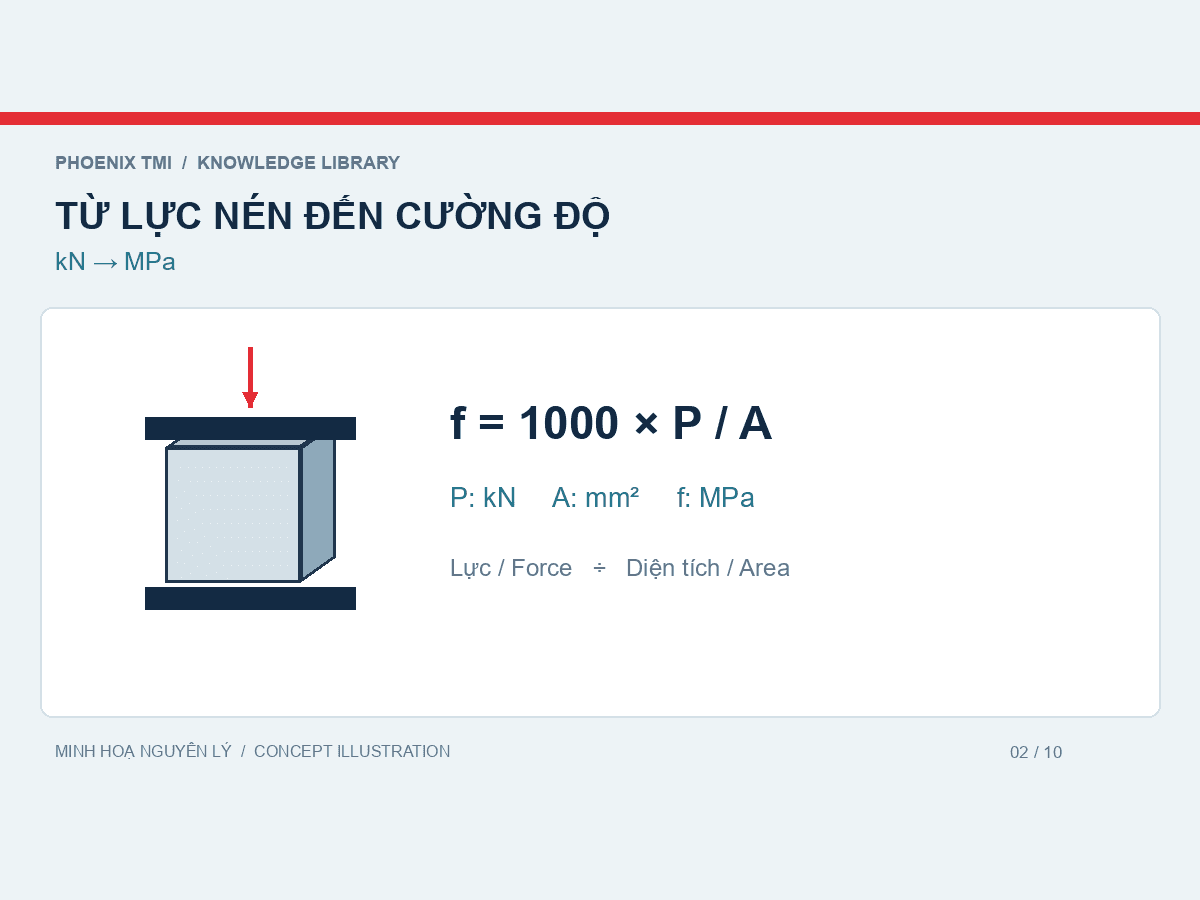
A failure load in kN is not concrete strength in MPa. Interpretation requires the loaded area, specimen geometry and test conditions as well as maximum load.
Concept illustration prepared for Phoenix TMI; not measured data or a manufacturing drawing.
Use consistent units
With P in kN and A in mm², f = 1000 × P / A gives N/mm², equivalent to MPa. Follow the method for dimensions, corrections and reporting. For illustration, a 150 × 150 mm face and 1,350 kN load give a basic value of 60 MPa. This is not an acceptance result or a universal specimen-conversion rule.
Investigate the specimen and setup
Review sampling, moulding, curing and age.
Confirm end preparation, positioning and fixtures.
Check dimensions, units and report settings.
Record unusual observations alongside peak force.
Cubes, cylinders and cores have distinct evaluation requirements. Retain preparation records and avoid informal conversion factors. Protect the test area according to equipment instructions.
Review the complete measurement
Hercules 3000 kN and Hercules 2000 kN support concrete compression configurations. Correct area entry, suitable calibrated ranges and appropriate platens matter alongside the frame.
Keep a traceable record
Record identity, method, age, dimensions, maximum force and strength, with relevant observations. These records make discrepancies easier to investigate than a pass/fail column alone.
References
This article explains principles and equipment selection. Perform testing to the required standard and equipment instructions.


